Dancing with technology: Creating immersive experiences for every body
By Jonny Norridge and Neil Halliday | Published on 6 October 2026
Categories: Press office; NTU Arts; Research; School of Art & Design;
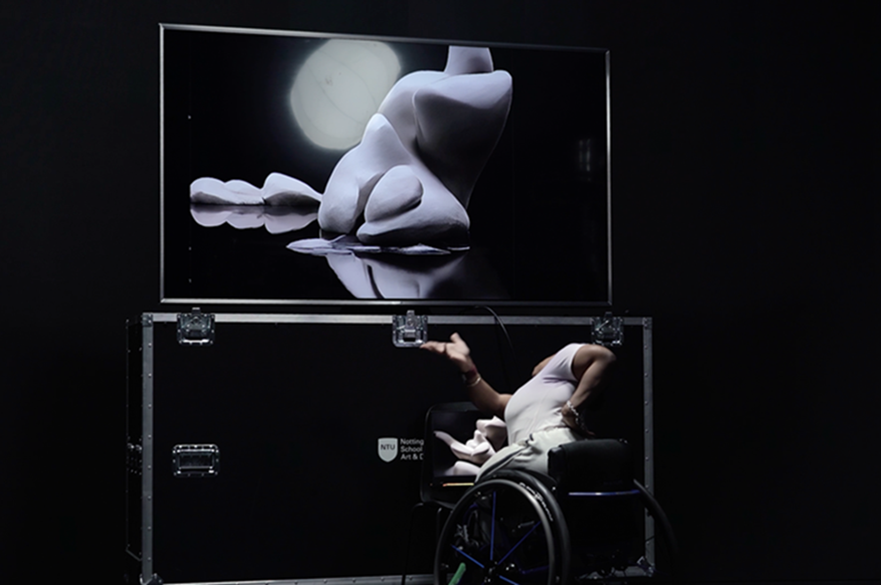
Dance has been described as a universal language. As visual artists with a strong background in motion graphics and digital storytelling, we were interested in exploring how emerging technologies could expand that language into immersive digital spaces. Yet many of the tools used to create digital dance experiences are not designed with all bodies in mind. Motion capture systems, for example, frequently assume certain physical abilities, body proportions and movement patterns.
The Immersive Inclusive Dance (I2D) project at Nottingham Trent University (NTU) aimed to create inclusive, immersive, and accessible dance experiences. Funded through NTU’s Knowledge Exchange Programme, I2D brought together dancers, students, researchers, and creative technologists to investigate how digital tools support new artistic expression. The project's goal was not simply to digitise dance, but to create immersive experiences that celebrate the diversity of human movement.
Putting People First
A key principle of the project was its human-centred approach. Working through a process of user-centred experimentation, we explored how dancers with a wide range of physical abilities and dance styles could be captured and represented within digital environments. Accessibility was considered at every stage, from how movement data was captured to how dancers ultimately appeared in immersive artworks.
The project experimented with a range of technologies, including LiDAR scanning, motion capture suits and creative coding platforms. One of these was P5.js, an open-source JavaScript tool. Using a standard webcam, P5.js allowed us to capture movement in real time and quickly transform it into dynamic visual outcomes. Its accessibility and flexibility made it an ideal environment for rapid experimentation with different forms of movement and representation.
Inspired by Artistic Exploration
Technology was only one part of the story. The project also drew inspiration from a wider cultural conversation about how artists and designers represent the human body. In particular, we noted the work of design studio’s Universal Everything, United Visual Artists and the sculptor Antony Gormley. Gormley’s practice explores the body not as a fixed object but as a space of possibility and experience. This perspective encouraged us to move away from creating exact digital replicas of dancers. Instead, digital representations became playful explorations of colour, shape, texture and movement.
We also explored TouchDesigner, a visual programming platform for performance and interactive media. We prompted AI systems within TouchDesigner to generate imagery in response to real-time camera inputs. This allowed movement itself to become a creative trigger, producing evolving visuals that responded directly to the dancer's presence and actions. Dancers were able to witness imagery responding to their movements in real time. This created a playful feedback loop between performer and technology, with dancers experimenting with different gestures, speeds and poses to influence the visuals being generated. The dancers described this immediate responsiveness as one of the most engaging aspects of the project, turning the technology into an active creative collaborator rather than simply a recording tool.
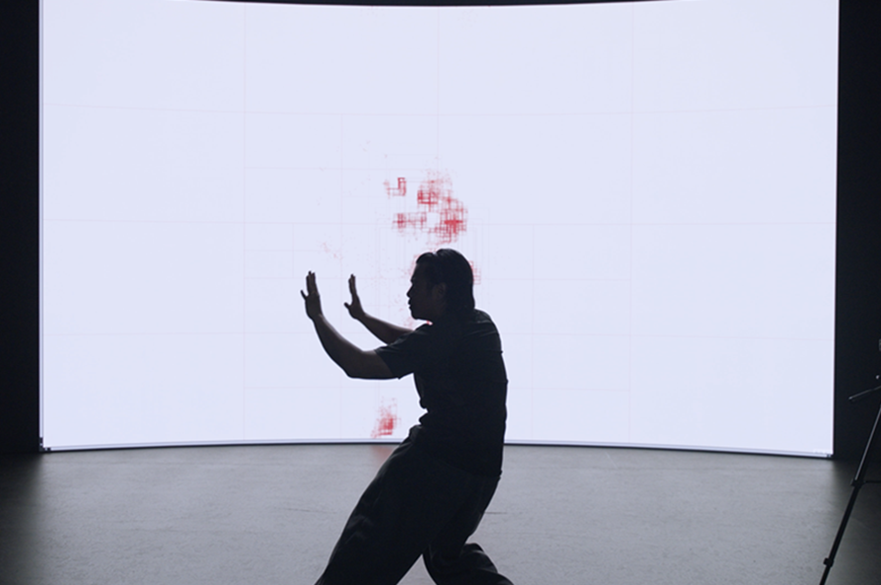
An example of artwork from I2D
Learning From Dancers
As will already be apparent, central to the project's success was collaboration with dancers themselves.
We collaborated with Beatbots, a Nottingham-based hip hop dance collective and charity that promotes wellbeing through accessible community dance, and Stopgap Dance Company, an internationally recognised for their commitment to: “nurturing the talents of dancers born into any body and any mind including disabled and neurodivergent performers.”
These partnerships provided invaluable insight into how different people experience movement and performance. Rather than treating dancers as subjects of research, the project positioned them as collaborators whose expertise shaped both the creative and technical development of the work.
Their involvement helped reveal not only what technology could do, but also where it was falling short.
The Challenges of Motion Capture
Testing traditional motion capture suits revealed significant challenges. Many motion capture systems require performers to wear specialist suits and complete a calibration often this involve a standardised “T-pose". While these assumptions may seem minor, they can create significant barriers for people whose bodies or movement patterns do not fit expected norms.
The team found that the suits could be difficult to put on, restrictive to wear, and sometimes incompatible with different body types. In some cases, these limitations reduced accessibility altogether.
There was also a creative challenge. Most motion capture systems are designed to collect movement data that will later be processed and rendered into finished visuals. The real-time feedback often appears as a basic mannequin-like figure, offering little inspiration for performers during the creative process.
The research highlighted how many current technologies contain hidden assumptions about what a body should look like and how it should move. By identifying these biases, the project was able to explore more inclusive alternatives through tools such as webcam-based tracking, creative coding and AI-assisted visualisation.
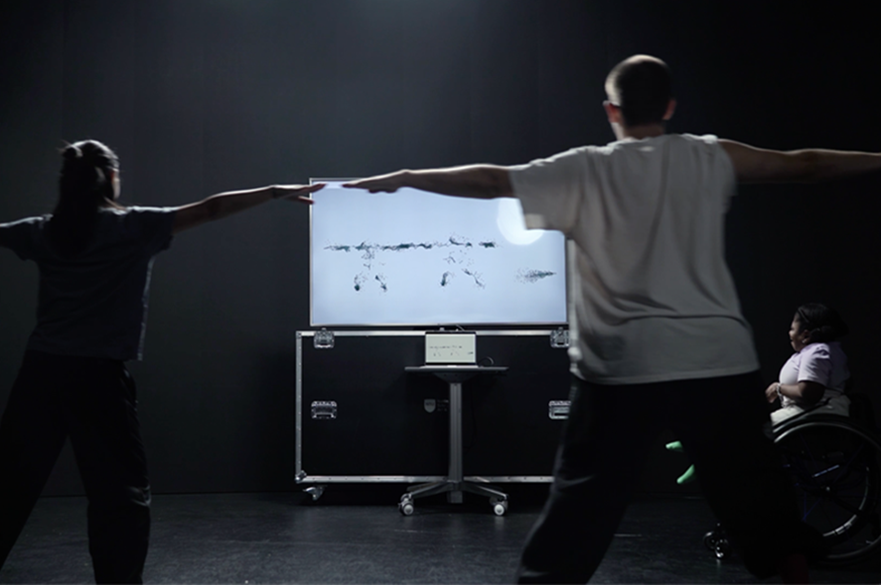
People collaborating with I2D
New Possibilities for Immersive Performance
The project demonstrated that when artists, technologists and performers work together, the results can be far greater than the sum of their individual contributions.
Dancers involved in the research were enthusiastic about the potential for new forms of performance that blend movement, technology and immersive environments. In particular, many enjoyed interacting with the methods that provided live visual feedback. The real-time nature of the systems encouraged improvisation and experimentation, creating a dialogue between dancer and digital environment that would not be possible with traditional post-production workflows. The team also found that scale plays an important role in audience experience. Life-sized, or even larger-than-life, digital representations created a much stronger emotional and visual impact, particularly when displayed on large virtual production screens.
Perhaps most importantly, the project showed that inclusive design can lead to more creative outcomes. By moving beyond the constraints of traditional motion capture workflows, we were able to explore representations of movement that were expressive, abstract and responsive to the individuality of each performer.
While the work is still evolving, I2D highlights an exciting future for inclusive digital creativity. By challenging assumptions built into existing technologies and placing people at the centre of the design process, projects like this can help ensure that immersive experiences reflect the full diversity of human movement.
Ultimately, the future of dance technology is not just about innovation. It is about making sure that everyone has the opportunity to be seen, represented and celebrated.
Immersive Inclusive Dance (I2D) is a project by Jonny Norridge & Neil Halliday. The work is currently exhibited in the the D&DA Building 28th September - 9th October 2026.
Immersive Inclusive Dance (I2D) is based around user-centred interactive technical experimentation to explore motion tracking with dancers from diverse backgrounds in immersive digital art. Funded by NTU’s Knowledge Exchange Program. This research project aims to showcase how existing and emerging technologies can be used to generate and create, new inclusive immersive dance experiences.