Bonington Gallery exhibition: Alan Lodge Common Grounds: Counterculture & Confrontation since 1976
This autumn, Bonington Gallery will present the first major survey of photographer Alan Lodge, one of the UK’s most important chroniclers of alternative culture, protest movements, and grassroots activism.
By Sarah McLeod | Published on 7 July 2026
Categories: Press office;
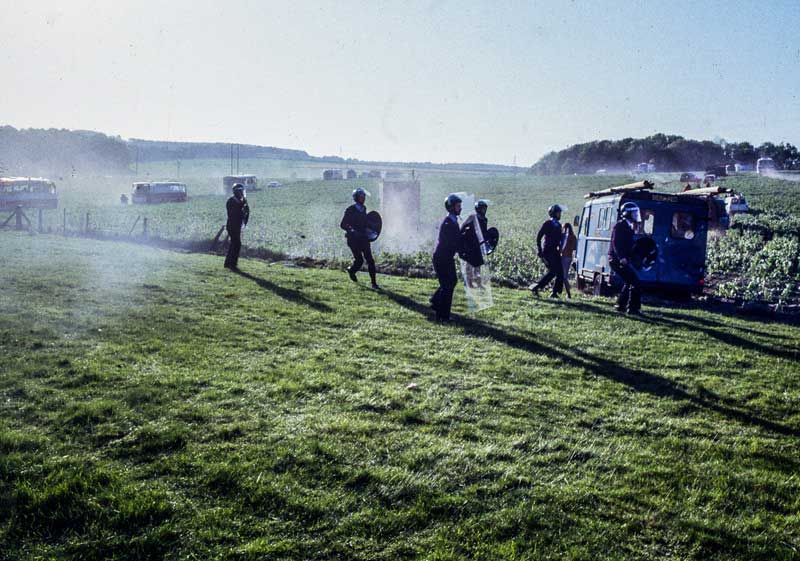
Spanning five decades, the exhibition brings together work documenting travelling communities, free festivals, rave culture, environmental campaigns, and anti-war protests. As a member of a travelling community for many years, Lodge offers a rare insider perspective into the people, places, and subcultures that emerged beyond mainstream society, exploring how they have shaped Britain’s social and cultural landscape over the last 50 years.
Celebrating a life dedicated to activism, the exhibition traces Lodge's journey from the free festival movement of the 1970s, to cultural celebrations and headline-making events, reflecting on the changing relationship between citizenship, protest, environmental concern, public space and state authority.
After a brief career as an emergency paramedic in the London Ambulance Service, Alan “Tash” Lodge took up photography and documented the emerging free festival movement in the late 1970s. In 1985, Lodge and his family joined the Peace Convoy on its annual journey to Stonehenge, where he was involved with, and photographed, the clashes between the police and travellers in what became known as the Battle of the Beanfield, resulting in one of the most violent mass arrests in British history.
In 1990, Lodge moved to Nottingham to study photography at Trent Polytechnic (now Nottingham Trent University), where he became involved with the city’s influential music collective DiY Sound System, which held free parties across the UK. Among his most celebrated images are those capturing partygoers at Castlemorton Common in Wiltshire, widely regarded as the largest illegal rave in British history, which led to the introduction of the Criminal Justice Act in 1994.
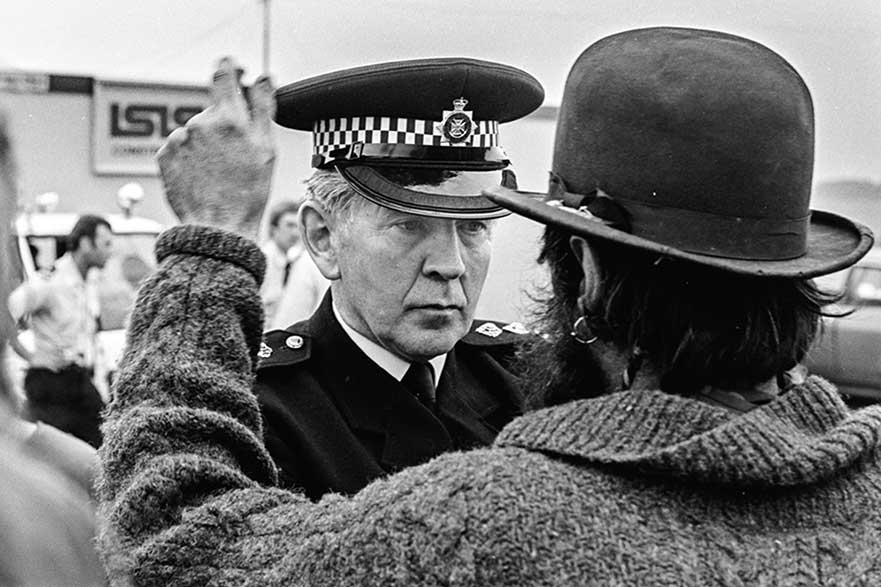
Alan Lodge. June 1981 Confrontation, Summer Solstice, Stonehenge Free Festival. © Alan Lodge
Lodge’s work has appeared in publications and journals worldwide. His photographs have also been featured in documentaries and films, including Operation Solstice for Channel 4, Jeremy Deller’s BBC documentary Everybody in the Place: an Incomplete History of Britain 1984-1992 (2018)and most recently Aaron Trinder’s documentary ‘Free Party: A Folk History’ (2023). He was interviewed for Daniel Ward’s film, Lonesome Ghosts (2025), show at Peer, and spoke to Stewart Lee about the Battle of the Beanfield in the R4 podcast ‘What happened to Counter-Culture?’
In recent years Lodge has continued to extensively document his involvement and attendance of public demonstrations and festivals, and is active in various welfare and advice agencies, including Festival Welfare. Lodge is known for his documentation of police surveillance and was a regular contributor to Indymedia UK. His website offers guidance on the rights of photographers documenting public places and demonstrations.
Featuring around 80 photographs alongside 35mm slide projections, moving image, personal archives and previously unseen material, the exhibition traces Lodge’s extensive career. Also presented will be legal correspondence and documentation relating to his own encounters and legislative actions with the police and authorities, highlighting questions around civil liberties, surveillance and the rights of photographers in public spaces.
Tom Godfrey, Director, Bonington Gallery, said:
“I am delighted to be exhibiting Alan’s work in Nottingham, a figure so connected to the city and region but whose impact goes well beyond. His photographs offer an important visual history of the people and communities that have shaped modern Britain, but who are often overlooked in mainstream historical narratives. Charting five decades of alternative culture, the exhibition highlights ongoing questions around protest, civil liberties, police surveillance and land access, which feels very pertinent to our current moment.”
Exhibition details:
Alan Lodge: Common Grounds: Counterculture & Confrontation since 1976
25 September – 12 December 2026
Bonington Gallery
Exhibition Launch: Thursday 24 September, 6-8pm
Notes for Editors
Press enquiries please contact Sarah McLeod, Corporate Communications Manager, on telephone +44 (0)115 848 8735, or via email.
About Bonington Gallery
Founded in 1969, Bonington Gallery has been at the forefront of Nottingham’s rich and vibrant visual arts community for over fifty years, offering an innovative and dynamic programme of local, national, and international significance. Situated at the heart of Nottingham Trent University’s School of Art & Design, our ‘art school’ context is reflected throughout our multi-disciplinary programme of exhibitions and events – presenting and exploring practices related to visual art, fashion, film, music and design. Beyond our building, our connections with colleagues in academic subject areas help ground our programme and thinking within past, present and future cultural and societal discourse.
About Nottingham Trent University
Nottingham Trent University (NTU) has been named UK ‘University of the Year’ five times in six years, (Times Higher Education Awards 2017, The Guardian University Awards 2019, The Times and Sunday Times 2018 and 2023, Whatuni Student Choice Awards 2023) and is consistently one of the top performing modern universities in the UK.
Students have voted us first in the UK for course quality, top five in the UK for employability and third best University in the UK (Uni Compare 2027). We are ranked in the top 25 universities in the country (The Guardian University Guide 2026).
We have over 35,000 students and more than 4,000 staff located across five campuses. It has an international student population of over 5,000 and an NTU community representing over 160 countries.
NTU owns two Queen’s Anniversary Prizes for outstanding achievements in research (2015, 2021). The Research Excellence Framework (2021) classed 83% of NTU’s research activity as either world-leading or internationally excellent.
NTU was awarded GOLD in the national 2023 Teaching Excellence Framework (TEF) assessment.
NTU is a top 10 for sport (British Universities and Colleges Sport league table 2025) and was named as Sports University of the Year (Daily Mail University Guide 2025).
NTU is a holder of the University Mental Health Charter, recognising the commitment an institution has shown towards continuous improvement in the area of mental health and wellbeing.
NTU is the most environmentally sustainable university in the UK and third in the world (UI Green Metric University World Rankings, 2025).