The Blue Wave: Memes and movements for change
The blue wave, a series of online political memes depicting a Democratic surge ahead of the 2026 US midterm elections, became a shared visual expression of expectations for change. Dr Tine Munk examines how humour and digital imagery can challenge political narratives and connect online expression with wider movements for change.
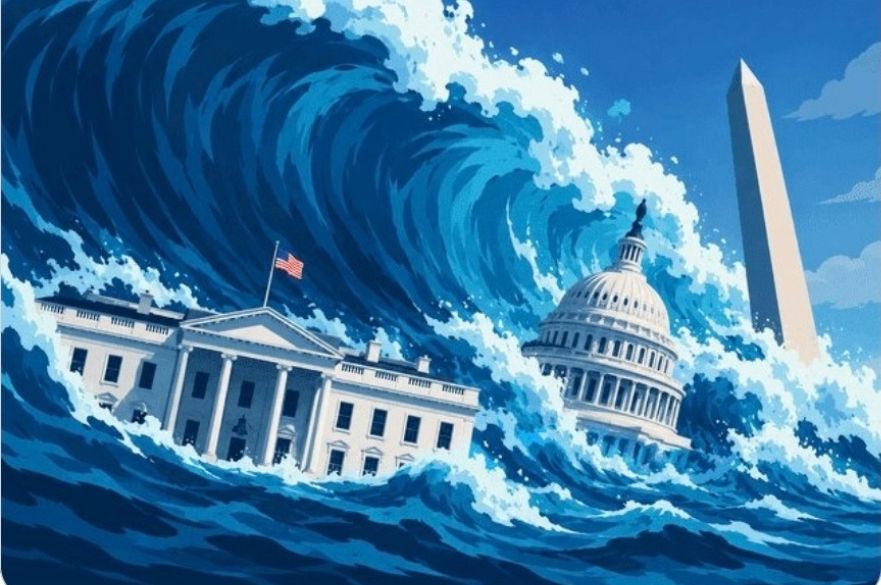
A blue tsunami sweeping towards Washington. US President Trump desperately paddling a small golden MAGA boat away from an enormous wave. American flags caught in the rising water.
Across social media, political memes anticipated a Democratic victory in the US midterm elections on 3 November 2026. The images varied, but the message stayed the same: a blue wave was coming, bringing changes to the US.
The midterms shifted the balance of power in the US Congress amid considerable domestic and international turmoil. Political and economic concerns, along with dissatisfaction with the Trump administration, shaped public debate during the election campaign.
Among the many political messages circulating online, the Democrat-aligned blue wave memes deserve attention. They reveal how humour and visual communication can challenge political narratives and encourage participation.
How a wave became a political symbol
Political communication relies on recognisable symbols. Trump’s red MAGA hat communicates political identity and belonging. The Democrats have their donkey symbol, just as the Republicans have their elephant. But neither has the same contemporary visibility and cult-like status as the MAGA hat.
In an era of doomscrolling, online posts and memes must compete for attention in crowded social media feeds. Familiar symbols and visual codes help audiences recognise and decode political messages almost instantly.
Anyone can adapt these images, adding humour and their own political interpretations. This brings political debates into everyday digital spaces. As people created and circulated their versions, the blue wave became a shared visual expression of political expectations.
From political spectacle to defensive resistance
Political memes are often viewed through the lens of hostility and polarisation or dismissed as little more than online entertainment. Yet this overlooks their potential to encourage political participation and resistance.
Trump and his administration have used digitally manipulated imagery extensively to attract attention and promote political narratives. Recent Truth Social images merging Trump’s face with Elvis Presley’s or portraying Greenland as an American military stronghold illustrate how political spectacle blends absurdity with real geopolitical tensions.
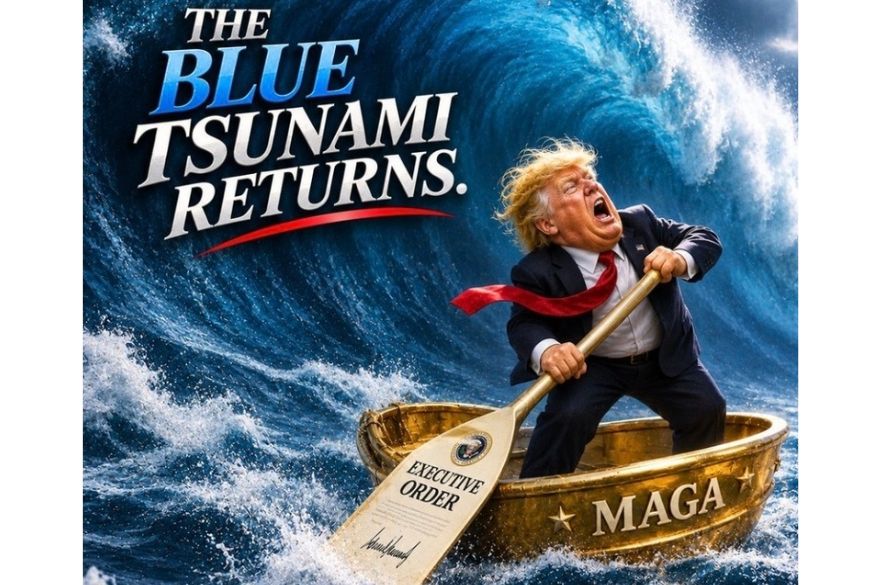
The blue wave offered a different narrative: defensive memetic resistance that went beyond ridiculing political opponents to communicate hope and the possibility of change.
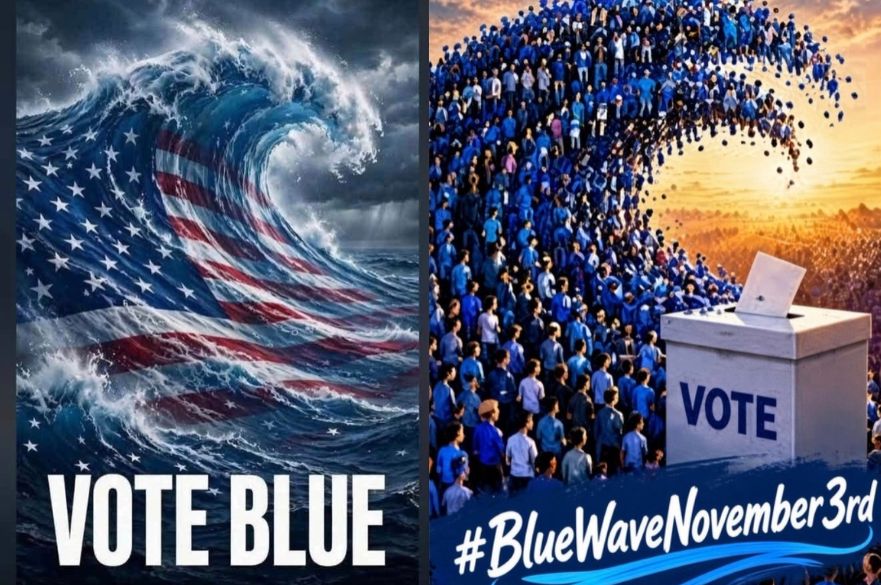
A repeating ‘Vote Blue’ message encouraged electoral participation, where giant waves approaching Washington suggested that political power was not permanent. Others showed Trump desperately escaping the tsunami, turning political uncertainty into visual satire.
Election memes also depicted the Statue of Liberty fighting back and referenced corruption allegations and the Epstein files.
Yet the blue wave stood out. Its creative variations made it memorable in crowded social media feeds, while its message is easy to understand.
The approaching wave captured a growing sense that Congress’s balance of power could shift and bring changes.
The playful imagery made political engagement feel more accessible, encouraging people to interact with and share these memes throughout the election campaign.
However, beneath the humour lay a serious message about the electorate’s power. The blue wave encouraged people to look beyond their dissatisfaction with Trump and recognise voting as an opportunity to shape the political future.
Hybrid civic movements and political change
The American midterms come amid growing political mobilisation elsewhere - scenarios which illustrate how civic resistance is gaining visibility and momentum across interconnected online and offline spaces.
Some movements have already contributed to political change, while others continue to challenge established structures.
During autumn 2026, youth-led protests filled the streets of Paris and other European cities, including Berlin, reflecting frustration over education, living costs and political leadership.
In Hungary, April’s parliamentary election ended Orbán’s 16 years in power. Magyar’s government is still in its early days, but the political change has brought renewed hope and attracted attention beyond Hungary.
In Serbia, the deadly Novi Sad railway station canopy collapse in November 2024 sparked student-led protests that grew into a nationwide movement demanding accountability.
In October 2026, the student-backed movement won the parliamentary election. In neighbouring Albania, student-led protests have gained momentum, challenging corruption, education costs and limited opportunities for young people.
Beyond Europe, Nepal’s Gen Z protests brought down the government in September 2025, followed by elections that produced new political leadership. In India, the Cockroach Janta Party developed from online satire into a nationwide youth-led protest movement.
These developments recall a not-so-distant past that somehow feels a lifetime away. The Scorpions’ Wind of Change from 1990 captured the hope surrounding the fall of the Berlin Wall, the democratic revolutions across Eastern Europe, and the collapse of the Soviet Union in 1991. People challenged state propaganda, the political system, and imagined a different political future.
Today’s circumstances are different, but echoes of that optimism are slowly emerging, even if it is too early to speak of a wider political shift.
Can a meme really make a difference?
This is one of the most difficult questions in political meme research. Sharing an image does not necessarily mean someone will vote, attend a demonstration or change their political views.
People engage with memes for different reasons, making their influence on political behaviour difficult to measure.
Memes can turn individual frustrations into a visible expression of collective concern, giving people a sense that others share their views.
They can also foster hope for a different political future and keep these conversations alive in a rapidly changing social media environment.
The blue wave illustrates something important about political communication. Its influence cannot be reduced to votes gained or opinions changed.
The images gave people a way to join the political conversation and contribute to a shared sense of what the election might bring.
Perhaps the significance of the blue wave lies less in whether it changed people’s minds and more in how it gave people a voice in a wider political conversation.
The memes turned political uncertainty into something people could recognise, respond to and make their own. They remind us that political change begins when people believe it is possible.