Researchers aim to grow optical fibres using biology instead of machinery
A new project involving Nottingham Trent University aims to grow optical fibres using proteins, mimicking a process that has occurred in nature for millions of years.
By Dave Rogers | Published on 8 October 2026
Categories: Press office; Research; School of Science and Technology;

The Northumbria University-led project is one of 11 R&D Creator teams selected by the Advanced Research and Invention Agency (ARIA) to receive funding under its Universal Fabricators programme.
Backed by £50 million overall, the programme will run for an initial three years, tasking teams with developing scalable manufacturing processes that use proteins as tools to build advanced materials.
Northumbria has been awarded just over £3m from ARIA for the project, which is led by Professor Meng Zhang, Professor of BioSciences at Northumbria University, in collaboration with partners led by Carole Perry, Distinguished Professor at Nottingham Trent University and Professor Kunal Masania at TU Delft in the Netherlands.
Professor Zhang has described the potential of biotechnology to transform how everyday materials are designed and produced as “the next industrial revolution”.
Conventional optical fibre manufacturing relies on heating glass to temperatures of more than 1,500°C and drawing it into shape using highly precise machinery.
The complexity of the fibre structures are limited by the fundamental principles of the heating-and-drawing fibre making process.
There is a wide scope of future data transmission needs that would require a level of structure complexity unachievable by this conventional process.
Instead, the research team will engineer proteins whose genetic sequence directs both their self-assembly into fibrous templates and the nucleation of silica.
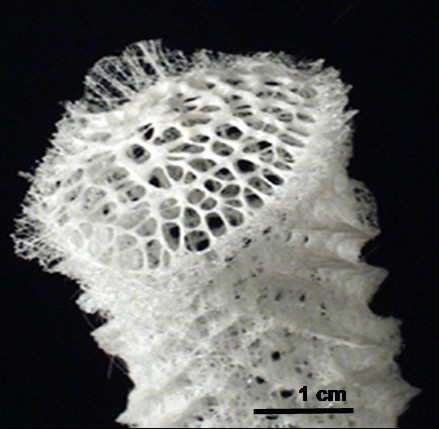
Silicified sponge (Image: Distinguished Professor Carole Perry)
The strategy is inspired by how marine sponges and diatoms biomineralise silica at ambient temperature and pressure.
These organisms have evolved to produce exquisite microstructures in mild sea conditions that engineers can only dream of.
The team aims to replicate these principles to develop a more precise and environmentally friendly route to highly complex glass fibres.
Speaking about the research, Professor Zhang said: “Biology has been engineering precision materials for millions of years, and it can achieve accuracy that surpasses anything we can currently do with machinery.
“Our project is about harnessing that natural capability and engineering it so that we can achieve those same properties, but with features that match the needs of modern society.
“Because this natural process happens in mild conditions at room temperature, rather than under intense heat and force, it also uses far less energy.”
This is believed to be the first time this manufacturing approach will be attempted for optical fibre production.
The type of fibre being targeted is known as hollow-core optical fibre. It carries light through a core of air rather than solid glass, allowing light to travel faster and with less signal loss than in a conventional fibre.
Growing hollow-core fibres of this kind using proteins is one of three engineering challenges set by ARIA's Universal Fabricators programme, each paired with a product that industry needs but cannot currently mass produce.
Hollow-core fibre is increasingly seen as a key technology for the next generation of digital infrastructure, in particular in meeting the demands of the AI boom, with it being used to connect data centres over greater distances with lower latency, supporting the huge growth in computing power needed to run AI systems.
The same properties make it attractive for high-speed financial trading, where fractions of a second can carry significant value, and for long-distance telecommunications networks more broadly, where several companies have recently begun rolling out early commercial routes using this technology.
The global optical fibre market was valued at more than £7.9 billion in 2025, but production remains dominated by energy-intensive, high-temperature manufacturing processes.
This project aims to show that the same high-performance fibres, of the kind increasingly in demand for data centres and telecoms networks, could instead be produced using a low-energy, biological process, offering a more sustainable route to meeting that demand.
Northumbria University leads the project, focusing on the biology and engineering, decoding the information nature uses to determine material properties, and using DNA sequencing to reproduce that information in engineered proteins.
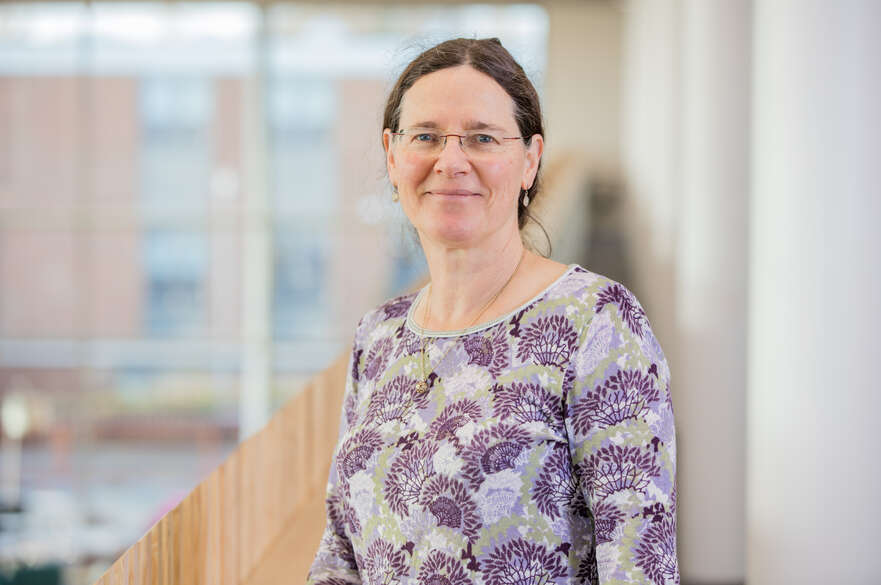
NTU Distinguished Professor Carole Perry
TU Delft will take the resulting protein fibres and produce them at metre and kilometre scale, while Nottingham Trent University will work on producing the silica materials.
Following this initial research, the Northumbria team will focus on optimising the fibre's properties for use as a functioning optical fibre.
Professor Zhang, whose background is in microbial biotechnology, said the project reflects a wider shift taking place in the field of biotechnology.
She explains: “My work looks at how proteins can be used as functional tools, not only limited as catalysts, to produce advanced materials. It's a genuinely challenging area to communicate, because so much of it happens at a scale you can't see.
“Projects like this help translate that science into something tangible that people can picture and understand. I believe biotechnology represents the next industrial revolution; in the way steam power and internet technology were before it.”
Distinguished Professor Perry, who is based in Nottingham Trent University’s School of Science and Technology, said: “We are delighted to be working with the teams at Northumbria and TU Delft. The funding from ARIA enables me to return to my research roots and apply fundamental knowledge of biomineralization in the production of materials for the 21st century.
“Further benefits of being ARIA creators are interactions with a wide group of scientists and engineers all interested in the application of fundamental science to tackle societal problems.”
Dr Valeria Puddu and Dr Matt Addicoat are also part of the Nottingham Trent University team.
Notes for Editors
Press enquiries please contact Dave Rogers, Public Relations Manager, on telephone +44 (0)115 848 8782, or via email.
About the Universal Fabricators programme
ARIA's Universal Fabricators programme is backed by £50 million and led by Programme Director Ivan Jayapurna. It funds 11 R&D Creator teams to develop scalable manufacturing processes that use proteins as tools to build advanced inorganic and composite materials, tackling three engineering challenges: growing hollow-core optical fibres (1D), membranes for separating critical minerals (2D), and rare earth-free magnets (3D).
About ARIA
ARIA (the Advanced Research and Invention Agency) is an R&D funding agency created to unlock technological breakthroughs that benefit everyone. Created by an Act of Parliament and sponsored by the Department for Business, Innovation, Science and Trade, we fund teams of scientists and engineers to pursue research at the edge of what is scientifically and technologically possible.
About Nottingham Trent University
Nottingham Trent University (NTU) has been named UK ‘University of the Year’ five times in six years, (Times Higher Education Awards 2017, The Guardian University Awards 2019, The Times and Sunday Times 2018 and 2023, Whatuni Student Choice Awards 2023) and is consistently one of the top performing modern universities in the UK.
Students have voted us first in the UK for course quality, top five in the UK for employability and third best University in the UK (Uni Compare 2027). We are ranked in the top 25 universities in the country (The Guardian University Guide 2026).
We have over 35,000 students and more than 4,000 staff located across five campuses. It has an international student population of over 5,000 and an NTU community representing over 160 countries.
NTU owns two Queen’s Anniversary Prizes for outstanding achievements in research (2015, 2021). The Research Excellence Framework (2021) classed 83% of NTU’s research activity as either world-leading or internationally excellent.
NTU was awarded GOLD in the national 2023 Teaching Excellence Framework (TEF) assessment.
NTU is a top 10 for sport (British Universities and Colleges Sport league table 2025) and was named as Sports University of the Year (Daily Mail University Guide 2025).
NTU is a holder of the University Mental Health Charter, recognising the commitment an institution has shown towards continuous improvement in the area of mental health and wellbeing.
NTU is the most environmentally sustainable university in the UK and third in the world (UI Green Metric University World Rankings, 2025).