Shoppers overwhelmed by detailed AI-generated recommendations
Too much information from AI-generated shopping recommendations can leave consumers feeling overwhelmed and less likely to make a purchase, according to new research.
The study by Nottingham Business School, part of Nottingham Trent University (NTU), and WuYi University, China, found that consumers responded most positively when recommendations included a moderate amount of explanation.
Recommendations with too little information left people uncertain about why a product had been suggested, while highly detailed explanations left shoppers feeling overloaded and less confident in their decisions.
Across a series of experiments involving almost 1,845 shoppers in China, participants who were given explanations with a few relevant reasons why the product might suit them were more likely to trust recommendations, find them useful and feel comfortable acting on them.
In contrast, the researchers found that lengthy explanations can create information overload, making shopping decisions feel more complicated than they need to be. In some cases, consumers became more sceptical of recommendations when the AI appeared to provide excessive justification for its suggestions.
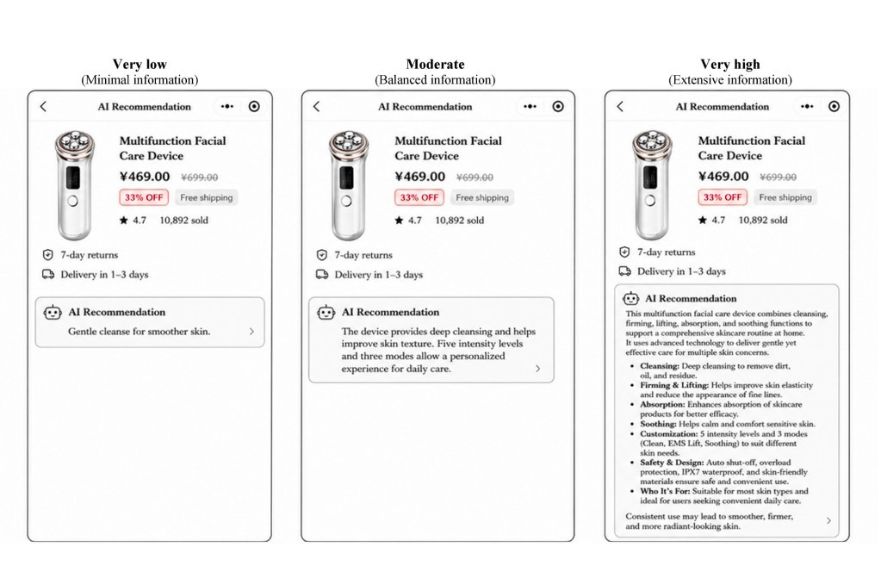
Examples of AI-generated shopping recommendations with very low, moderate and very high levels of explanatory details.
In a separate experiment on a Chinese shopping platform, recommendations were shown 51,248 times. Shoppers made a purchase on 2.78% of occasions when they saw a moderate amount of detail, compared with 1.63% when they saw very little and 1.40% when they saw the most.
Dr Gomaa Agag, Associate Professor of Marketing at Nottingham Business School and part of the Marketing and Consumer Studies Research Group, said: "Most of us encounter AI recommendations when we shop online, stream entertainment or use digital services, sometimes without even realising it.
"We found that people want to understand why something has been recommended to them, but there must be a balance. The best recommendations are those that give people enough information to make an informed choice without creating unnecessary complexity.”
The findings could help retailers and technology companies improve the way AI-powered recommendations are presented across online shopping platforms, travel websites, streaming services and other digital products used by millions of consumers every day.
Dr Agag added: "As AI becomes a bigger part of everyday life, getting that balance right will be essential for building trust and creating a better experience for consumers."
The research 'Too little, too much, or just right? How AI recommendation information volume shapes trust and consumer behavior' has been published in the Journal of Retailing and Consumer Services.
Notes for editors
About Nottingham Business School at Nottingham Trent University
Nottingham Business School (NBS) at Nottingham Trent University (NTU) is a leader in experiential learning and personalisation of business, management and economics education and research - combining academic excellence with positive impact on people, business and society. NBS has an unrivalled level of engagement with business, public and voluntary organisations. With more than 8,500 students, NBS is also one of UK’s largest business schools.
NBS is part of the 1% of business schools worldwide to hold the Triple Crown of accreditation from EQUIS, AMBA and AACSB. It is also accredited by Small Business Charter, providing support and development for SMEs, and is a PRME Champion - held up as an exemplar and beacon by the United Nations Principles of Responsible Management Education (PRME).
In The Guardian University Guide 2026, all NBS subjects were ranked in the UK Top 20. Areas covering Accounting and Finance, Business and Management, Economics and Marketing and PR were all recognised for excellence in teaching, high student satisfaction and strong graduate career prospects.
About Nottingham Trent University
Nottingham Trent University (NTU) has been named UK ‘University of the Year’ five times in six years, (Times Higher Education Awards 2017, The Guardian University Awards 2019, The Times and Sunday Times 2018 and 2023, Whatuni Student Choice Awards 2023) and is consistently one of the top performing modern universities in the UK.
Students have voted us first in the UK for course quality, top five in the UK for employability and third best University in the UK (Uni Compare 2027). We are ranked in the top 25 universities in the country (The Guardian University Guide 2026).
We have over 35,000 students and more than 4,000 staff located across five campuses. It has an international student population of over 5,000 and an NTU community representing over 160 countries.
NTU owns two Queen’s Anniversary Prizes for outstanding achievements in research (2015, 2021). The Research Excellence Framework (2021) classed 83% of NTU’s research activity as either world-leading or internationally excellent.
NTU was awarded GOLD in the national 2023 Teaching Excellence Framework (TEF) assessment.
NTU is a top 10 for sport (British Universities and Colleges Sport league table 2025) and was named as Sports University of the Year (Daily Mail University Guide 2025).
NTU is a holder of the University Mental Health Charter, recognising the commitment an institution has shown towards continuous improvement in the area of mental health and wellbeing.
NTU is the most environmentally sustainable university in the UK and third in the world (UI Green Metric University World Rankings, 2025).