Artificial Intelligence is transforming the world — from healthcare and sustainability to engineering, sport performance and digital creativity. At the School of Science and Technology, we’re preparing our students to lead this change.
Empowering students for innovation
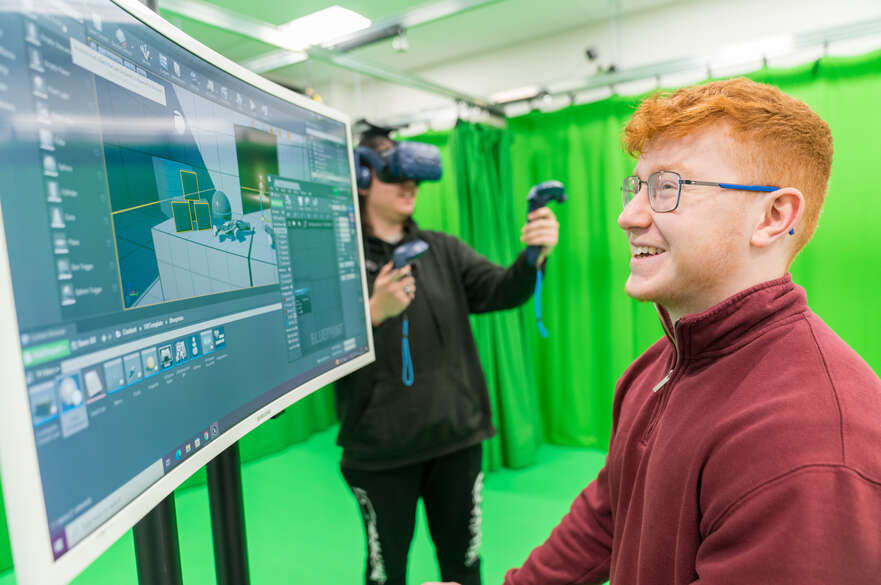
Across our diverse subject areas, AI is embedded in teaching, research and hands‑on experiences. Students learn to apply intelligent tools to real scientific and technological challenges — from modelling complex systems to interpreting large‑scale datasets.
Whether you’re analysing biological data, solving complex engineering challenges or developing next‑generation software, you’ll gain the digital and analytical skills to thrive in a rapidly evolving world. You’ll also benefit from opportunities to collaborate across disciplines, experiment with emerging technologies and build practical experience that reflects the needs of modern industry.
Students can expect to:
- Use AI‑powered tools in labs, workshops and project work
- Explore how automation and data science are transforming STEM careers
- Develop critical awareness of responsible and ethical AI use
- Build confidence in applying AI to real‑world scientific and technical problems
How are science and technology courses responding to AI
Here are a few examples of how our courses are responding to AI.
Investigating with AI
Our students explore how AI is transforming research, healthcare and biotechnology. They use AI to help investigate complex biological questions, create realistic research scenarios and interpret large biological datasets. By applying biological theory to authentic challenges, students develop an understanding of how AI can support scientific discovery while learning to evaluate AI-generated outputs for accuracy, reliability and scientific validity.
AI in the Real World
Students examine how AI is being used in industry from disease diagnosis and drug discovery to genomics, personalised medicine and environmental monitoring. They explore how AI can identify patterns within large datasets, model disease progression and predict biological outcomes that may not be immediately visible through traditional analytical approaches. Alongside understanding the potential benefits for healthcare innovation, research efficiency and sustainability, students are encouraged to question the limitations of AI systems and consider the ethical, legal and societal implications of their use in biological research and healthcare decision-making.
Research and Professional Skills
Through practical projects and independent research, students explore how AI can support scientific inquiry by generating ideas, summarising complex information and identifying knowledge gaps. They learn how to use AI tools responsibly when reviewing literature, analysing data and presenting research findings to different audiences. These experiences help students develop critical digital and analytical skills, preparing them for careers in bioscience, healthcare, biotechnology and research sectors where AI is becoming an increasingly important part of professional practice.
Investigating with AI
Our students explore how AI is transforming chemical research and discovery. They use it to investigate complex chemical concepts, explore reaction pathways and develop realistic research scenarios. By applying chemical theory to scientific challenges, students learn how AI can support problem-solving while developing the skills needed to evaluate the accuracy, reliability and limitations of AI-generated information.
AI in the Real World
Students examine how AI is increasingly being used across chemistry, from predicting chemical reactions and designing new materials to accelerating drug development and advancing sustainable chemistry. They explore how AI can identify patterns in experimental data, optimise laboratory processes and support development of solutions to global challenges. Alongside understanding the potential benefits for research efficiency, innovation and sustainability, students are encouraged to assess AI-generated outputs and consider the ethical, environmental and professional implications of AI-assisted decision-making.
Research and Professional Skills
Through laboratory work and independent research projects, students explore how AI can support scientific research by generating ideas and summarising complex information. They learn to use AI tools responsibly when reviewing literature, analysing data and presenting research findings to specialist and non-specialist audiences. These experiences help students develop valuable digital, analytical and problem-solving skills, preparing them for careers in chemistry, pharmaceuticals, materials science, environmental science and related industries where AI is becoming an increasingly important part of professional practice.
Investigating with AI
Our students explore how artificial intelligence (AI) is transforming forensic investigations. They use generative AI (genAI) to create realistic crime and case-study scenarios, applying forensic theory to authentic investigative challenges. A key focus is developing the ability to critically evaluate AI-generated content, assessing its accuracy, reliability and limitations.
AI in the Real World
Students also examine how AI and machine learning are used in modern forensic practice, and how these technologies may continue to support and enhance the work of forensic professionals. For example, they investigate how automated pattern recognition can assist with fingerprint comparison, image analysis and evidence interpretation. Alongside the potential benefits for efficiency, effectiveness and sustainability within the criminal justice system, students are encouraged to question the legitimacy of AI-generated information and consider the legal and ethical implications of its use in forensic investigations and court proceedings.
Research and Professional Skills
Through independent research projects, students explore how genAI can support scientific inquiry by generating ideas, identifying gaps in knowledge and enhancing academic communication. They learn to use genAI responsibly when summarising information, refining written work and presenting findings to different audiences. These experiences develop valuable digital skills and prepare graduates for careers in an increasingly technology-driven forensic profession.
Investigating with AI
Our students explore how AI is transforming the study of physics, from fundamental particles to the large-scale structure of the universe. They use AI to investigate complex concepts, develop research scenarios and explore potential solutions to scientific challenges. Through applying physical principles to AI-supported investigations, students develop the skills needed to critically evaluate AI-generated content and assess its accuracy, reliability and scientific validity.
AI in the Real World
Students examine how AI and machine learning are being used across modern physics research and industry. From astrophysics and climate modelling to quantum systems and particle physics, they explore how AI can be used to simulate complex physical interactions, analyse large datasets and identify patterns that may not be immediately apparent through traditional methods. Alongside understanding the potential benefits for scientific discovery, innovation and computational efficiency, students are encouraged to consider the limitations of AI models and the ethical and practical implications of their use in research and decision-making.
Research and Professional Skills
Through laboratory work and independent research projects, students explore how AI can support research by generating ideas, summarising literature, identifying gaps in knowledge and enhancing scientific communication. They learn to use AI tools responsibly when analysing data, interpreting results and presenting findings to specialist and non-specialist audiences. These experiences help students develop valuable digital, analytical and problem-solving skills, preparing them for careers in physics, engineering, data science, research and other technology-driven sectors where AI is becoming an increasingly important professional tool.
Investigating with AI
Our students explore how AI is built upon mathematical principles and how these principles are applied to solve real-world problems. They use AI and computational tools to investigate mathematical models, analyse complex datasets and explore how algorithms make predictions and decisions. Through these activities, students develop a strong understanding of the mathematics underpinning AI while learning to evaluate AI-generated outputs for accuracy, reliability and potential bias.
AI in the Real World
Students examine how mathematics forms the foundation of modern AI systems through areas such as statistical modelling, optimisation, probability and data science. They explore how these techniques are used to train machine learning models, recognise patterns, make predictions and support decision-making across industries including finance, healthcare, technology and engineering. Alongside understanding the opportunities AI creates, students are encouraged to consider the limitations of mathematical models and the ethical implications of using AI in contexts where fairness, transparency and accountability are important.
Research and Professional Skills
Through problem-solving activities, computational projects and independent research, students explore how AI can support mathematical inquiry by generating ideas, explaining concepts and assisting with data analysis. They learn to use AI tools responsibly, ensuring that mathematical reasoning, verification and critical thinking remain central to their work. These experiences help students develop valuable analytical, computational and digital skills, preparing them for careers in mathematics, data science, finance, technology and other sectors where AI and quantitative decision-making play an increasingly important role.
Investigating with AI
Our students explore how AI is transforming the design, development and operation of engineering systems. They use AI to investigate engineering challenges, develop innovative solutions and explore realistic design scenarios. Through applying engineering principles to AI-supported problem-solving, students develop the ability to critically evaluate AI-generated outputs, assessing their accuracy, reliability and suitability for real-world applications.
AI in the Real World
Students examine how AI is driving innovation across modern engineering. From automation and robotics to smart manufacturing, predictive maintenance and future transport systems, they explore how AI can optimise performance, improve efficiency and support complex decision-making. Students investigate how intelligent systems can analyse large volumes of operational data, identify patterns and enable more responsive and sustainable engineering solutions. Alongside understanding the potential benefits of AI, they are encouraged to critically consider its limitations and the ethical, environmental and societal implications of its use.
Research and Professional Skills
Through design projects, laboratory activities and independent research, students explore how AI can support engineering practice by generating ideas, accelerating design processes and analysing information. They learn to use AI tools responsibly when evaluating solutions, interpreting data and presenting findings to technical and non-technical audiences. These experiences help students develop valuable digital, analytical and problem-solving skills, preparing them for careers in engineering sectors where AI-enabled technologies are becoming an increasingly important part of professional practice.
Understanding AI Technologies
Across our Department of Computer Science courses, students explore artificial intelligence (AI), from machine learning and neural networks to generative AI, ethical AI and responsible innovation. They develop an understanding of how intelligent systems are designed, trained and applied to solve real-world problems across a range of industries and sectors. A key focus is building the skills needed to critically evaluate AI technologies, including their capabilities, limitations and potential impact on society.
Designing the Future of Computing
Students investigate how AI is transforming modern computing, from intelligent software and data-driven decision making to automation and emerging technologies. Through practical activities and projects, they explore how machine learning models can be developed and applied, while considering the challenges of fairness, transparency, security and reliability. They are encouraged to think critically about the opportunities and responsibilities that come with developing AI-powered solutions.
Innovation, Ethics and Professional Practice
Throughout their studies, students learn how to use AI tools responsibly to support problem-solving, software development, research and communication. They examine the ethical, legal and societal implications of AI, considering issues such as bias, privacy, accountability and sustainability. These experiences help students develop valuable technical and professional skills, preparing them for careers in an increasingly AI-enabled digital world.
Investigating with AI
Our students explore how AI is transforming sport, exercise and health sciences. They use AI to investigate performance challenges, develop realistic case studies and explore evidence-based approaches to improving athletic performance and wellbeing. Through applying scientific principles to AI-supported scenarios, students develop the ability to critically evaluate AI-generated content, assessing its accuracy, reliability and relevance within sport and exercise contexts.
AI in the Real World
Students examine how AI is being used across sport science, from performance analysis and injury prevention to personalised coaching and athlete monitoring. They explore how AI can analyse large volumes of physiological, biomechanical and performance data to identify patterns, support decision-making and optimise training programmes. Alongside understanding the potential benefits for enhancing performance, improving health outcomes and supporting athlete development, students are encouraged to critically consider the limitations of AI technologies and the ethical implications of using data-driven approaches in sport and exercise settings.
Research and Professional Skills
Through practical projects and independent research, students explore how AI can support research by generating ideas, summarising findings and identifying gaps in knowledge. They learn to use AI tools responsibly when reviewing literature, analysing data and presenting findings to different audiences. These experiences help students develop valuable digital, analytical and problem-solving skills, preparing them for careers in sport science, performance analysis, coaching, health and wellbeing, and other sectors where AI-enabled technologies are becoming increasingly influential.