Quality Handbook supplement 12A - Guidance on course design requirements
This guidance explains NTU’s requirements for designing and delivering courses, helping course teams create structured, accessible and student-centred programmes that align with university policy, national qualification frameworks and professional standards.
Latest version as of September 2026.
On this page
1. Purpose and scope of the guidance on course design requirements
1.1 This guidance provides information and clarification to guide course teams in meeting the course design requirements as set out in NTU Quality Handbook Section 12: NTU Course Design Requirements.
1.2 Sections 2–6 of this document relate to the following aspects of course design and apply to all courses:
- Learning outcomes
- Personalised guided development
- Assessment (synoptic assessment and assessed work-like experience)
- Learning Engagement
- NOW Learning Rooms
1.3 Sections 7-11 apply to specific categories of courses as indicated in the respective section titles:
- Integrated Foundation Year (IFY) courses
- Foundation Degrees and Level 6 ‘top-up’ courses
- Higher National Certificates and Diplomas (HNC/HND)
- Apprenticeships
- Fully online courses
2. Course Structure
2.1 All courses must be designed to provide a coherent structure and scaffolded learning experience.
Options structure
2.2 For undergraduate courses, a course must contain an extensive core. Options are not allowed for the Integrated Foundation Year and Level 4.
2.3 At Levels 5 and 6, courses may include optional modules that allow students to shape their degree. However, they must form no more than 50% of the number of modules per level. Options must be structured into a maximum of three sets, with students choosing a single module from a maximum of four in each set. The total number of modules per level refers to the original number of modules without options, as illustrated in the following examples:
- Example 1: With a combination of 6 × Level 5 (20 credit) modules, the total number of Level 5 modules is 6. Therefore, the maximum number of modules in which options could be offered would be 3.
- Example 2: With a combination of 4 × Level 6 (20 credit) modules and 1 × Level 6 (40 credit) module, the total number of Level 6 modules is 5. Therefore, the maximum number of modules in which options could be offered would be 2.
3. Learning outcomes
Creating learning outcomes
3.1 Course design starts with identifying the aims of the course, and subsequently specifying the learning outcomes that are needed to meet these aims. Hence, identifying course learning outcomes is key to planning a course and its components.
3.2 Learning outcomes set the minimum achievement required for the satisfactory completion of the course or module.
3.3 The Quality Assurance Agency’s Framework for Higher Education Qualifications (2024) is a framework that sets out the different levels of higher education qualifications and the requirements for each of these. NTU’s level descriptors (as set out in QH Section 3: Undergraduate awards and QH Section 4: Postgraduate awards) align with this framework.
These generic learning outcomes identify the expected knowledge and understanding, skills and behaviour that a learner will achieve at the different levels of a course. The descriptors increase in complexity as the level increases (e.g., from Level 4 to Level 7). Therefore, the learning outcomes on a course and module must align with this framework and the NTU descriptors.
3.4 Course learning outcomes may also be defined by specific requirements of a Professional, Statutory or Regulatory Body (PSRB) and by the expectations in relevant QAA subject benchmark statements.
3.5 Learning outcomes indicate what is expected for a learner to achieve and are the basis for developing assessment criteria. They provide evidence that outcomes are matched against appropriate national frameworks and standards and PSRB requirements, and more importantly, against NTU course design and requirements.
3.6 Careful consideration must be given to the number of learning outcomes. In general, it is sensible to limit learning outcomes to the key skills, knowledge or competence that all students should be able to demonstrate upon completion of a module or course. The number will depend on the size and content of the module and will be relatively consistent across the course.
3.7 See the guidance on writing effective learning outcomes on Thrive (NTU staff login required) for further advice in designing learning outcomes.
Assessing learning outcomes
3.8 Assessment of all learning outcomes is crucial to demonstrate that students have completed their course. Hence, all course learning outcomes must be assessed in at least two of the modules that comprise the course. This is shown through a Curriculum Map, which demonstrates how course learning outcomes are assessed across modules at each level of study. A strong justification must be provided at course approval if this cannot be achieved (for instance, due to a PSRB requirement or the specific nature of the course).
3.9 As module learning outcomes are aligned with the course learning outcomes, they must be assessed and passed to confirm the achievement of the course.
3.10 A module’s learning outcomes must be assessed by a suitable assessment with clear information in the assessment criteria as to how that assessment will be graded by associated criteria. These assessment methods and criteria must be explicit and communicated to students through course handbooks and/or module guides and made available on the NTU Online Workspace (NOW).
3.11 While course teams should ensure that the assessment method(s) are sufficient to satisfactorily assess all the outcomes (particularly in large modules, e.g., over 40 credits) it is entirely acceptable for a module to be assessed by one element of assessment.
4. Personalised guided development
4.1 All courses must provide personalised guided development for all students throughout their academic journey. This is articulated in the Teaching and Learning Strategy section in the course information on CourseLoop.
4.2 In the design of the course, the following must be identified:
4.3 How all students will be supported at key transition points throughout their journey, including:
- the transition into university and course induction - courses must adhere to the Course induction guidance provided on MyHub;
- progression between academic levels;
- before, during and after placement; and,
- beyond university to further study and employment.
4.4 Identify what steps will be taken to facilitate social integration and a sense of belonging, including meaningful peer relationships, and signposting to social opportunities such as NTU Global, NTU Sport, and Community Engagement and Volunteering.
4.5 Identify what steps will be taken to meet the academic needs of each cohort of students, including their prior academic attainment and capability.
4.6 How personalisation within the course (such as goal setting, personal tutoring, optionality, assessment, placements) will facilitate success for all students, and how these opportunities will be clearly communicated to students in an accessible and timely manner.
4.7 How personal tutoring will provide personalised guided development through a structure that is embedded into the curriculum.
4.9 Identify ways to support students to recognise and articulate their academic, personal, and professional progress and achievements (e.g. through synoptic assessment), and to prepare them for life after university.
4.10 How the support structure within the course will scaffold each student’s academic, personal, and professional learning journey.
4.11 What methods will be used to ensure that wider opportunities for development and support are clearly communicated in an accessible and timely manner throughout the student journey. These may include:
- Academic support such as academic skills, online learning software, academic integrity and referencing available through the Library.
- Support available from a Student Mentor.
- Understanding the NTU Student Dashboard.
- English Language Support (such as Academic English at NTU, Academic English (In-sessional)), International Student Support, and NTU Faith and Chaplaincy.
- Pastoral support available through Student Services Centres (including enrolment and signposting to specialist areas such as health and mental wellbeing, finance support, and disability), and NTSU support such as housing advice.
- Employability support including: Careers guidance and job application support, In-curriculum employability skills development, awards, events, workshops, graduate recruitment initiatives and postgraduate study pathways – available through MyEmployability.
4.12 The policies and guidance below are relevant to designing personalised guided development strategies within a course. They can be found in NTU’s Quality Handbook:
5. Assessment
Course assessment strategy
5.1 The assessment strategy must reflect the assessment decisions that have been made by the course team so that the principles and purposes of assessment are addressed. The following requirements are reflected in the whole course assessment:
- assessment tasks are explicitly linked to module learning outcomes, bearing in mind that all course learning outcomes are assessed. The selected assessment methods must effectively enable students to demonstrate specific learning outcomes, whilst enhancing their learning (alignment);
- assessments from different modules must build on each other throughout the course at levels and years (both horizontal and vertical integration), creating a coherent student experience of the curriculum (coherence);
- there is a range of assessment types demonstrated at course level, ensuring opportunities for students to master required skills and gain understanding from feedback (balance);
- assessment load across the course is balanced and planned in advance to ensure staff and student workload can be managed. i.e., avoidance of deadlines bunching at particular times of the year and a balance of formative work and summative assessment;
- there is scaffolding of assessment throughout a course to allow progressively more challenge, supporting student development from novice to expert (progression).
5.2 The course assessment strategy must include reference to the following:
- inclusive approaches
- the language of assessment
- assessment tasks and their relationship to course learning outcomes
- anonymity in marking
- standardisation process
- feedback that feeds forward into future learning and assessment
5.3 A major project (or dissertation) is a substantial piece of independent academic work completed under supervision, designed to enable students to demonstrate the achievement of course learning outcomes through the application of appropriate research methods, critical analysis, and scholarly practice, in alignment with approved qualification standards. It is usually completed at the culmination of a course, requiring students to integrate and apply the knowledge, skills, and methods developed during their studies. It may take the form of a dissertation, research project, capstone project, or equivalent applied piece of work.
5.4 Category 3 - Professional or Practice Master’s Degrees - of the QAA Characteristics statement for Master’s Degrees are not required to include a major (research) project in the curriculum due to the nature of these courses. As outlined in the QAA Characteristics Statement for Master’s Degrees (February 2020), Category 3 master’s degree programmes are primarily designed to enable graduates to qualify for entry into a profession (subject to any additional conditions set by the relevant PSRB). Unlike Category 1 (Research Master’s Degrees) and Category 2 (Specialised or Advanced Study Master’s Degrees), which explicitly require students to undertake a substantial research project, Category 3 programmes are not bound by this expectation. Instead, the structure of Category 3 courses is typically shaped by professional standards and competencies, often in alignment with PSRB requirements. This means that learning outcomes may be achieved through practice-based assessments or applied coursework rather than a traditional major project or dissertation.
5.5 This guidance on synoptic assessment is not intended to mandate changes to existing practices across all courses. Rather, it aims to encourage course teams to reflect on their current and intended approach in light of this reimagined purpose and design of synoptic, viewed through the lens of Live, Learn, Work model at NTU. This is intended particularly for new courses and those intending to revamp existing courses.
Redefining our current approach to synoptic assessment
5.6 With the introduction of the Live, Learn, Work model at NTU, there is a valuable opportunity to refresh the approach to synoptic assessment in course design from a traditional academic exercise into a meaningful process of self-discovery and personal development. By reviewing current practice and ensuring that the assessment aligns with Live, Learn, Work principles in mind, the assessment should support students to reflect on their development and articulate how various experiences have shaped their perspectives throughout their academic journey.
5.7 Synoptic assessments should adequately guide students in recognising, articulating, and reflecting on a student’s complete learning journey. Teams need to assess whether students are encouraged to explore how their identity, values, and knowledge have evolved through their studies, and how the human factors (personal, social, and cultural influences) that shape who they are, have been integrated into their development. Supported by assessed work-like experience and expanded developmental opportunities throughout their course, students build the reflective skills to articulate their complete educational transformation rather than just academic achievement.
Purpose and design of synoptic assessment
5.8 The purpose of synoptic assessment is to enable students to demonstrate their holistic development throughout their university experience. The focus should be on authentic personal transformation and encouraging students to reflect on their growth as individuals and developing professionals.
5.9 A synoptic assessment enables students to demonstrate the knowledge, skills, and competencies they have developed throughout their course, including co-curricular and extra-curricular opportunities.
5.10 Rather than solely (or predominantly) assessing academic achievement, the synoptic assessment provides an opportunity for students to demonstrate their holistic development. By reflecting on their own learning, values, and identity, students can showcase how they have evolved across multiple dimensions — personal (Live), academic (Learn), and professional (Work). This approach encourages self-awareness and metacognitive skills, allowing students to capture the full scope of their educational transformation.
5.11 Course teams, based on their specific subject area or sector requirements, will decide the most appropriate assessment approach and module in the final year, aligning with the synoptic aim of summarising and presenting a general view of the whole from the student’s personal perspective.
5.12 To achieve the purpose of synoptic assessment, the following components should be integrated into the assessment design using the Live, Learn, Work model model:
- Personal Narrative. Students should tell their unique development story, highlighting how they have evolved personally, academically, and professionally. This moves beyond listing achievements to exploring the transformative experiences that have shaped their identity, values, and capabilities.
- Evidence-Based Reflection. Require students to provide concrete evidence of their development through artifacts, examples, references to professional competence, etc. This ensures authenticity and helps students recognise growth they might otherwise overlook. In some cases, inclusion of a reflection on their proudest moment or biggest achievement can help students express their growth and personal values.
- Critical Analysis of Growth. Students should analyse their development processes, not just describe what happened. To support this, encourage exploration of challenges overcome, lessons learned, and connections made between different experiences.
- Future-Oriented Planning. Consider including a component that demonstrates students' commitment to lifelong learning and continued development. This reinforces that education is an ongoing journey rather than a destination. Where appropriate, consider whether this can be broader than career goals i.e. aspirations for wider life experiences.
Synoptic assessment design principles
5.13 The assessment must adhere to the following principles:
- Flexibility and Choice. Depending on the course and department, there may be more suitable formats, focus areas, and evidence types that best represent the students’ individual journey. Where appropriate, facilitating a personalised approach supports diverse student groups and personal circumstances while maintaining assessment standards.
- Authentic Context. Positioning the assessment within a meaningful context (final year showcase, presentation, portfolio review) that mirrors real-world situations where students will need to articulate their development.
- Holistic Development Focus. Including suggestions on content areas: personal growth, cultural awareness, social responsibility, and lifelong learning aspects helps to capture the full educational experience and its transformative potential.
- Student Agency. Encourage students to take ownership of their learning story and develop their narrative, making choices about what to highlight and how to present their development. This can help to build confidence and self-awareness.
5.14 A synoptic assessment is typically presented as a distinct element of assessment towards the end of a course. However, in some cases, particularly within professional or competency-based courses, it may be more appropriate for the synoptic assessment to be embedded as an integral part of a major project. In such instances, a reflective approach is often adopted to support the development and production of the project. In both approaches, the synoptic assessment must be clearly articulated and appropriately reflected within the assessment criteria and module learning outcomes.
Examples of synoptic assessment
5.15 Examples of synoptic assessment briefs and student work and relevant resources which are aligned to the above design principles are accessible through:
5.16 The module which includes the synoptic assessment must be identified on CourseLoop via the module-level Contribution to course mandatory learning, teaching and assessment approaches field.
5.17 It is advisable to build in opportunities for formative assessment and feedback as students progress toward their summative assessment. Formative assessments take a range of forms, such as practice exams, workshops, practice lab sessions, portfolio checkpoints, etc.
5.18 Assessed Work-Like Experience (AWLE) at NTU is related to the globally recognised concept of “Work Integrated Learning” which draws from the fields of experiential learning, work-based learning, and vocational education and training.
5.19 As specified in Quality Handbook Section 12: Course Design Requirements, all undergraduate students must experience 240 hours of AWLE embedded across a full three-year course. This will be proportional for shorter UG courses. The proportion of AWLE for postgraduate taught (PGT) courses will be determined by the subject discipline and the need to improve graduate employment.
Design of AWLE
5.20 AWLE involves three parties: the student, the educational institution, and an external stakeholder. In this context, external stakeholders refer to individuals, employers or organisations from relevant sectors/industries who engage with students in a work-based or professional context. Students learn through authentic work-focused experiences, tasks and challenges which are an intentional and assessed component of the curriculum. This approach enables the integration of theory with meaningful practice that is relevant to the students’ discipline of study and/or professional development.
5.21 The following must be identified and embedded in the design of AWLE:
- AWLE should involve external stakeholders directly in the activity.
- AWLE needs to be assessed in-course, meaning that it contributes to the credit for the award, with all activities and assessment completed within the module(s) and before the relevant exam board.
- Time and space need to be created within the curriculum to allow students and external stakeholders to have a high-quality experience. A quality experience links theory with practice and supports the achievement of knowledge and skills to achieve desired outcomes.
- To best support AWLE experiences, the course design must include intentional and integrated preparation and structured reflection activities to enable students to understand the connection between theoretical knowledge and practical application and foster personal and professional growth.
- AWLE activities and the associated learning outcomes must be made explicit to students in course and module documentation.
- AWLE activity and hours are to be embedded and articulated within the total module learning hours and in a manner which ensures parity of workload for students. All AWLE activities and learning hours must be recorded on CourseLoop via the module-level Learning activities field.
- In most cases, work-like experience activities and assessment should span across Levels 4, 5 and 6. For courses with a requirement for a professional practice placement and where appropriate, it may be contained within a single module or designated credit-bearing modules. Additional support and resources can be found on our SharePoint under Embed Assessed Work Like Experience (NTU staff login required).
6. Learning engagement
6.1 Learning engagement time comprises two broad learning methods:
- Directed learning: broadly made up of facilitated activities, both synchronous and asynchronous, that a student is expected to undertake each week or to complete during scheduled teaching time to meet the learning outcomes.
- Guided independent learning: activity undertaken by students beyond directed learning. Guided independent learning is not scheduled and is completed in the students’ own time.
6.2 Learning engagement time accounts for the total number of hours of expected learning for a module. Weekly learning engagement time must be planned to include both directed learning and guided independent learning.
7. NOW Learning Rooms
7.1 In designing courses, course teams must consider and decide how to use digital technologies to enhance learning and teaching and communicate this to students. All courses must use the University’s virtual learning environment (NOW) for this purpose.
NOW content specification
7.2 All courses and modules must use the NOW Learning Room templates.
7.3 The default Learning Room home page must be adhered to. The default home page has been designed to support consistency in design, accessibility, and best practice in layout. Request for a custom home page must be approved by the VLE Business Manager in the EQP Flex Team.
7.4 The three default units, namely: “Start Here, Module Information, and Assessment units”, and related content items must be retained and updated accordingly, as shown below:
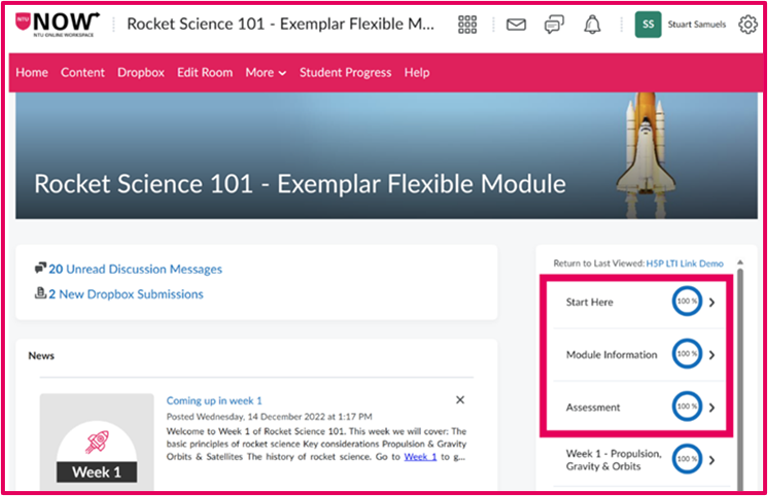
7.5 Assessment details should be provided at the start of the module and, at the latest, before the end of the first teaching week.
7.6 See Quality Handbook Supplement 12B: Requirements for the use of digital technologies in learning, teaching and assessment for detailed requirements of NOW content specification.
Accessibility of NOW Learning Rooms
7.6 The NOW Accessibility Statement describes how NTU makes NOW accessible and what to do if there are problems accessing any part of it. All learning rooms must achieve a minimum Blackboard Ally score of 85%+ for any new content; legacy content must achieve a minimum of 70% to increase to 85%.
7.7 The Learning Room Accessibility Statement, located within the Module Information section, must be updated using the Learning Room Blackboard Ally Report, providing the initial overall accessibility score for the content within the learning room, and with information on how students on the module can access alternative formats or request accessibility support. This must be updated periodically throughout the delivery of the module as content is added and accessibility improved where appropriate.
7.8 Nottingham Trent University is committed to ensuring that the platforms and resources that it uses with staff and students are accessible and comply with The Public Sector Bodies (Websites and Mobile Applications) Accessibility Regulations 2018 No.952. The more accessible the content is, the better it can be used across environments and devices by the largest possible number of users.
7.9 For support in creating accessible resources, contact flexiblelearning@ntu.ac.uk.
8. Integrated foundation year (IFY)
8.1Developing a course with an Integrated Foundation Year (IFY) entails careful consideration of different aspects of course design as well as student funding and operational requirements which are unique to IFY courses. This guidance aims to provide greater clarity on areas for consideration in developing courses with IFY in order to ensure consistency of design approach and parity of student experience across NTU’s IFY courses. These include course design, course titles, entry criteria, Banner course code build process, course transfer process and PSRB requirements.
8.2 An Integrated Foundation Year is designed to form the first year of a four-year undergraduate degree, commonly referred to as Year 0 (Level 3), followed by Levels 4, 5, and 6. It is fully integrated into the overall undergraduate degree structure. It provides a critical entry pathway for students who do not meet the academic or skills-based requirements for direct entry into Level 4.
8.3 The IFY provision at NTU supports widening participation and student success by offering an accessible route into higher education for students who:
- Do not have sufficient qualifications, subject knowledge, or academic experience for Level 4 entry.
- May be returning to education or transitioning from non-traditional educational backgrounds.
- Need time and structured support to develop confidence and capabilities essential for undergraduate study.
8.4 Through the Foundation Year, students develop the academic, subject specific, and study skills needed to progress successfully onto a bachelor’s degree course, improving both continuation and retention outcomes.
8.5 The key benefits of an IFY for students are:
- Skill Development: Acquire academic writing, critical thinking, and independent study skills foundational for degree-level success.
- Supportive Transition: Adjust to university expectations within a structured and supportive learning environment.
- Continuation Pathway: Clearly mapped route from foundation to degree level study, reducing the risk of early withdrawal.
8.6 An undergraduate degree with an IFY spans four academic years:
- Year 0 - Foundation Year (Level 3). Focuses on developing core academic competencies, subject knowledge, and transferable skills. Delivered within a supportive, scaffolded learning environment.
- Years 1-3 - Undergraduate Degree (Levels 4–6). Students can progress into the standard undergraduate curriculum of their chosen course once they meet the required continuation criteria at the end of the Foundation Year.
8.7 Additional pathways include:
- Integrated Master’s with Foundation Year (IFY + Integrated Master’s programme, 5 years total). Combines the IFY with an extended undergraduate programme that includes a final year at master’s level (Level 7). This five-year route is designed for students pursuing advanced academic or professional careers in disciplines where postgraduate-level expertise is required.
- Undergraduate Sandwich Degrees with Foundation Year (typically 5 years). Includes a placement year (usually between Years 2 and 3 of an undergraduate degree). This integrates a year of professional experience or study abroad alongside the academic curriculum, offering students enhanced employability and real-world skills.
8.8 An IFY is designed to feed into a specified undergraduate degree course. Students apply to a specific course with an integrated foundation year (e.g., BA (Hons) Business with Foundation Year), and continuation from Year 0 (Level 3) to Year 1 (Level 4) is guaranteed (see further information below) provided the student completes Year 0 and meets the academic requirements.
8.9 This structure enables curriculum alignment between the Foundation Year and subsequent degree levels, ensuring students gain relevant preparatory experience for their intended discipline.
Further information
- All integrated foundation degrees at NTU require a minimum of 64-72 UCAS tariff points for entry. Continuation to Level 4 is subject to meeting specific academic criteria, like passing assessments during the IFY.
8.10 When designing an Integrated Foundation Year, it is important to recognise that students will come from a range of backgrounds, with varying levels of academic experience and confidence. The IFY should offer support for students that is tailored to meet their specific needs and circumstances to help them adjust to university life. It is crucial to adopt a clear Level 3 approach to curriculum and pedagogy. This means recognising that IFY is not a simplified version of undergraduate study, but a distinct, purposeful stage. As such, the course should be intentionally structured to reflect Level 3 expectations, providing students with the necessary skills and knowledge to succeed in their chosen degree program.
8.11 There must be explicit guided development and scaffolding of learning throughout the year, focusing on supporting entry to the course and integration to NTU community; developing the foundations of academic, personal and professional skills; the management of learning and assessments; understanding how to use feedback; and preparation for Level 4. This approach ensures that students are not overwhelmed and are supported in building the skills and mindset required for the rest of their course. Taking this approach positions the IFY as a vital, learner-centred foundation for future success, rather than viewing it as a Level 4-lite. Creating a supportive environment where students feel valued and understood is key to helping them succeed with an IFY.
8.12 The design of courses with Integrated Foundation Years must follow the NTU Course Design and Approval policy (Quality Handbook Section 5) and comply with the Course Design Requirements (Quality Handbook Section 12). Course teams must consult relevant stakeholders, including Professional Services, in the course design process.
8.13 IFYs should normally be included in the curriculum map for the full undergraduate course. However, it is recognised that there may be instances where, due to the nature of the IFY, developing a curriculum map that incorporates it would not add meaningful value. In such cases, course teams may exclude the IFY from the curriculum map, provided a clear and justified rationale is set out.
8.14 Course teams should consider the external examining arrangement for IFYs during course design and approval.
8.15 In CourseLoop, the course title will be recorded using the following protocol:
- {Qualification} {course title} (with foundation year)
- For example: BSc (Hons) Accounting and Finance (with Foundation Year)
8.16 For consistency, the public title of courses with an IFY must follow the protocol below:
- {Qualification} {course title} (with foundation year) {mode}
- For example: BSc (Hons) Accounting and Finance (with foundation year) FT or BSc (Hons) Accounting and Finance (with foundation year) SW
8.17 Due to character limits in the ‘Banner course title’ field on the course build proforma, Schools can replace ‘(with foundation year)’ with ‘FY’.
8.18 Graduation titles will not state ‘with foundation year’ in the course title.
8.19 General guidance on course titling can be found in Quality Handbook Supplement 3C: Course Titling.
8.20 Courses with IFY must not offer a fallback award upon completion of Level 3 modules due to student funding regulation. Units of academic credit can be awarded to students upon completion of Level 3 modules if they decide not to continue or have not successfully met the academic requirements to continue onto Level 4 of their course.
8.21 Entry tariff: When a new course with an IFY is approved it is recommended that the published tariff is 72 UCAS tariff points from 3 A-levels (or equivalent qualification). Portfolios will be reviewed on a case by case basis but the entry tariff for courses with an IF should not be below ‘64 UCAS tariff points from 3 A-levels (or equivalent qualifications)’. Courses with an IFY will be incorporated into relevant annual tariff review exercises.
8.22 Subject requirements: If a course without an IFY specifies an A-level subject requirement, then the course with an integrated foundation year should replicate these subject requirements but these should be achieved at a minimum of Level 2 (GCSE or equivalent).
8.23 GCSE requirements: GCSE English and GCSE Maths will be required at a minimum of Grade C / 4. A higher grade requirement can be set if required.
8.24 Additional entry requirements: If a course without an IFY states additional entry requirements, such as an Enhanced Disclosure and Barring Service Check then these should be replicated for the aligned course which includes an integrated foundation year.
8.25 When a suite of courses is being developed, students can be taught together if this provides a suitable structure to support their success in developing the skills and knowledge required. However, each course will still need a separate banner code and all full-time bachelor courses should be open for UCAS applications and marketed.
8.26 If students transfer to a sandwich course and/or integrated master’s course, separate course builds and banner codes will be required for all appropriate transfer routes. However, only the bachelor’s full-time banner code will be available for applications on UCAS.
8.27 In summary, IFY Banner codes must be created for the following purposes:
- Full-time bachelor’s degree courses – open for recruitment
- Sandwich bachelor’s degree courses – transfer Banner codes
- Integrated master’s (MChem, MBiol etc) full-time and sandwich courses – transfer Banner codes
8.28 Following enrolment, requests to transfer to a different course should be managed by the School’s internal transfer process.
8.29 Students must only be transferred to another ‘with Integrated Foundation Year’ course. This is to ensure students continue to receive Student Loan Company funding. Following a course transfer request, the Student Loans Company will reassess the student's eligibility for funding based on the length of the new course. Study on a previous course in Higher Education impacts eligibility.
8.30 Further guidance on student finance, tuition fees and funding can be given by NTU’s Student Money Team. The Student Money Team offers support and guidance to students who need help figuring out their finances during their studies and can book a money advice appointment.
8.31 Any PSRB accreditations need to be sought to be applied to the course with an IFY.
8.32 Any accreditation on an existing non-integrated foundation year course does not automatically apply to the course with an integrated foundation year. The relevant accrediting body must be approached and a request made for accreditation to be applied to the course which includes an integrated foundation year.
8.33 The following are examples of NTU courses that have been approved with an Integrated Foundation Year. When designing courses, these examples could provide insights about effective course design features and practices in other schools.
- BSc (Hons) Biomedical Science (with Foundation Year)
- BA (Hons) Business (with Foundation Year)
- BSc (Hons) Wildlife Conservation (with Foundation Year)
- BA (Hons) Content Creation (with Foundation Year)
8.34 The above examples include:
- approved module structures;
- Level 3 learning outcomes (Level 3 descriptors are set out in Quality Handbook Section 3; and
- examples of assessment types.
9. Foundation degrees and Level 6 ‘top-up’ courses
Foundation Degrees
9.1 Foundation degrees are Level 5 qualifications that combine academic study and work-based learning. The QAA Foundation degrees characteristics statement sets out expectations that employers will be involved with the course design and delivery of foundation degrees. Students will experience 160 hours of assessed work-like experience spread over the duration of the course, for example, 80 hours at L4 and 80 hours at L5.
9.2 Progression to study after the foundation degree to an honours degree needs to be identified and recorded in CourseLoop via the course-level Foundation degree progression relationship(s) field for both the foundation degree and honours degree courses. Further study could include a stand-alone L6 ‘top-up’ course or the opportunity to capitalise on the recognition of prior learning to join an existing NTU honours degree beyond the starting point. For more information, see Quality Handbook Supplement PS3 Requirements for foundation degree progression.
Level 6 ‘top-up’ courses
9.3 Top-up courses are designed to build on prior learning to enable students to achieve a full honours degree. It needs to be recognised at the course design stage that students joining a top-up course can come from a range of academic backgrounds (e.g. Foundation degrees or HNDs) and could have studied previously at another university. Therefore, course design needs to incorporate a bespoke induction programme (including introducing students to NTU systems and digital technologies), diagnostic assessments, scaffolded academic skills development, flexible learning pathways and inclusive teaching strategies to ensure all students are supported in bridging potential gaps and achieving the degree successfully. These must be articulated in the Teaching and Learning strategy section on CourseLoop.
10. Higher National Certificates and Diplomas (HNC/HND)
10.1 Higher national awards are Levels 4 (HNC) and 5 (HND) courses that are vocationally focussed to develop and underpin knowledge and understanding while honing practical skills using work-based learning to produce industry ready graduates.
10.2 NTU deliver, award, assess and quality assure Higher National qualifications under the Intellectual Property Licence agreement with Pearson Education Ltd. This means NTU is granted permission to use the title and intellectual property from certain Pearson BTEC Higher National qualifications in order to provide its own Higher National qualifications. Course teams must consult and align with the discipline-specific Pearson specification. Under the licence agreement, certain aspects must be adhered to, such as:
- The course title must match that of the Pearson specification.
- Module (unit) titles must match those of the Pearson specification.
- Unit learning outcomes cannot be changed.
- In some instances, the Pearson specification will provide a set structure of units, for example, in order to meet the Higher Technical Qualifications (HTQ) quality mark. These specified units must be delivered in order to meet the HTQ quality standard and therefore meet the occupational standard.
- Where there is no set structure of units, Pearson specifications will provide core and optional units. Core units must be delivered, but it is up to the course team to decide on which optional units they wish to deliver to make up the full credits for the award.
- Credit values for each unit cannot be changed and will either be 15 or 30 credits.
10.3 Please note that the set structure of units Pearson presents in specifications for HTQs will be approved by Skills England (formerly the Institute for Apprenticeships and Technical Education (IfATE)) and will align with a named occupational standard.
10.4 Other aspects of the course design must adhere to NTU course requirements.
10.5 Higher National awards are graded differently from NTU Grade-Based Assessment (GBA). See the Quality Handbook 16E: Common Assessment Regulations for Higher Nationals awards for how units and final awards are graded.
10.6 Pearson awards describe modules as units. Unit learning outcomes are the equivalent of module learning outcomes. Unit learning outcomes cannot be changed. Course teams must, however, use the unit learning outcomes to create their own course learning outcomes. Having the freedom to create course learning outcomes provides course teams with an opportunity to ensure other aspects of NTU course requirements and learning opportunities are met through careful consideration of assessment methods over the course of the award. NTU has the authority to approve appropriate assessment methods and strategy for the course. For example, synoptic assessment can be embedded into Pearson units through the opportunity to reflect at the end of a project-based unit.
10.7 Higher national awards are highly vocational, and the unit learning outcomes lend themselves well to real world work-based assessments and assessed work-like experience (AWLE).
10.8 The opportunity to progress on to further study at NTU must be articulated in CourseLoop. Further study could include a standalone L6 ‘top-up’ course or the opportunity to capitalise on the recognition of prior learning to join an existing NTU course beyond the starting point.
11. Apprenticeships
11.1 Higher and degree apprenticeships combine hands-on experience with higher-level study to provide the knowledge, skills and behaviours required to:
- Become occupationally competent;
- Gain a higher education qualification.
11.2 Apprentices must be employed and therefore, apprenticeship course design must be cognisant of the demands of work and higher-level study.
Guided development
11.3 In addition to Progress Reviews, all apprentices, at all levels, should be allocated a Personal Tutor. Refer to section 3 of this document for guidance on NTU’s expectations to Personal Tutoring.
Apprenticeship course structure
11.4 Apprenticeship course design must be planned for the full calendar year, and there must be evidence of at least one planned, new learning activity every month (for example: during the summer, course design may include timetabled sessions for the 1st July and again on 25th August).
11.5 Prior to the enrolment of apprentices, the Apprenticeships Quality and Compliance Team require confirmation of:
- Course start and end dates
- Delivery schedule broken down by modules, including start/end dates
- Planned directed learning and guided independent learning hours per module.
11.6 It is important that this information is accurate as these dates are inputted into the apprenticeship training plans, learner agreements and employer agreements that are signed at the course commencement.
Apprenticeship delivery and learning hours
11.7 Apprenticeship training programmes comprise two types of training: on-the-job and off-the-job training, and apprenticeship course design must plan for both types. NTU is responsible for the off-the-job training, but this must align with what the apprentice does in the workplace. Apprenticeship Funding Rules dictate the minimum number of planned off-the-job hours (per week), and NTU apprenticeship course design must exceed (or at least meet) the total minimum hours for the duration of the training programme.
11.8 In addition to the guidance provided in section 5 of this document relating to learning engagement, please note that there are three approaches to recording learning activities in CourseLoop for all apprenticeship modules:
- Directed Learning: This is learning facilitated by academic staff, normally face-to-face. This learning is classed as off-the-job training.
- Guided Independent Learning: This activity is undertaken by apprentices beyond directed learning. This is not scheduled and is completed by apprentices independently but still within their contracted working hours. This learning is classed as off-the-job training.
- Directed Learning or Guided Independent Learning where the Type of Work-Like Experience is Employer-Based – other: This is learning that takes place in the workplace where apprentices master the knowledge, skills and behaviours that are being developed through the module.
Apprenticeship core curriculum
11.9 British values: The University is required to support apprentices to develop a knowledge and context appropriate understanding of the fundamental British values whilst on their training programme. During the course design phase, colleagues should consider and highlight themes related to British values and how these can be contextualised for the subject discipline.
11.10 English and maths development: It is important that the planned off-the-job training develops apprentices’ confidence and competence in English and maths for them to be successful in their role.
11.11 Career development: Although in employment, apprenticeship training programmes require ensuring apprentices have the knowledge they need to make informed decisions about their next steps. Course design should embed how careers provision is tailored to meet the needs and ambitions of apprentices.
Apprenticeship course approval
In CourseLoop
11.12 In addition to the standard fields required for course approval, Ofsted requires training providers to evidence some additional features of apprenticeship training programmes. It is a requirement to respond to the following points within the course-level General Apprenticeships Information field on CourseLoop:
Skills need
- How does this apprenticeship meet the local, regional and/or national demand?
- How does the apprenticeship aim to meet the needs of employers, professional bodies and the wider sector skills gaps (could utilise some of the market intelligence from the business case here, as well as an overview of the information gained from initial employer discussions)?
Curriculum features
- Articulate how learning and teaching support the apprentices’ development and awareness of:
- British Values and Prevent;
- Wellbeing and Safeguarding;
- English and Maths.
Course currency and staff Continuing Professional Development
- Briefly describe the strategy that ensures the course content remains current and applicable to industry.
- Articulate how employers are involved in the operation of the apprenticeship.
- How are staff delivering the off-the-job training supported to maintain working knowledge of the industry?
End-Point Assessment
- Explain how end-point assessment will be managed and how apprentices are supported in meeting the Gateway requirements.
- For Integrated End-Point Assessments (EPAs), describe the procedures, standardisation, allocation of Independent End-Point Assessors (IEPAs), grading, confirmation of academic award classification and how the EPA contributes, and the role of any Professional and Statutory Regulatory Bodies (PSRB) (where applicable).
- For Non-Integrated EPAs, describe the role of preparatory workshops and how these will be scheduled, how Gateway will be managed and the liaison with employers. [Note: it is the employer’s responsibility to put the apprentice forward for EPA and to identify a suitable end-point assessor organisation.]
Additional documentation
11.13 In addition to the Assessment & Feedback Plan and Curriculum Map, apprenticeship courses must provide a Knowledge, Skills and Behaviours mapping and a delivery plan which includes a breakdown of off-the-job hours, by module. To ensure this is captured correctly, course teams should meet with a member of the Apprenticeships Quality Team to complete the required template.
Apprenticeship external regulation
11.14 External regulation of apprenticeships is different to standard provision. Apprenticeship training programmes are highly regulated by multiple bodies, and NTU Apprenticeship Course Design must be compliant with all.
Please see the function of each accountable body below:
- Overall accountability for apprenticeship programmes, apprenticeship policy and strategy.
- Operation of the Apprenticeship Service and Apprenticeship Provider and Assessment Register (APAR). The DfE also operate apprenticeship funding and auditing of training providers.
- Develop, approve and review apprenticeship standards and end-point assessments (EPA).
- Approve the funding bands for apprenticeship standards.
- Inspection of apprenticeship training at all levels including Levels 6 and 7. However, these inspections are not focused on the higher education award or the delivery of academic standards.
- Regulates qualifications, examinations and assessments in the UK. Where apprenticeships include a qualification on the Register of Regulated Qualifications, they are subject to Ofqual.
- The OfS provide information to Ofsted and takes account of Ofsted inspections in the regulation of providers on its Register.
- The OfS is also responsible for delivering external quality assurance (EQA) for integrated degree apprenticeships in England.
- Oversees professional body assessments and accreditation of degrees/awards
12. Fully online courses
12.1 Guidance by Quality Matters, Office for Students and QAA highlights the importance of consistent, meaningful interaction in online courses. This means ensuring that every week includes some form of instructor-student engagement.
For example:
- News announcements
- Video or audio check-ins
- Participation in discussion forums
- Q&A sessions
12.2 It also involves setting clear service expectations, like responding to queries within 48 hours and providing feedback every week to keep students supported and engaged.
12.3 Learners must have opportunities to interact with classmates every week through structured activities like discussions, group projects, peer review, or collaborative problem-solving. In line with Quality Matters and QAA guidance, these interactions must be intentionally designed and tied to learning goals, rather than ad hoc. View the exemplar online module Rocket Science 101 for examples.
12.4 Online courses must integrate an appropriate blend of synchronous and asynchronous learning activities. All asynchronous (on-demand) learning must be accompanied by well-structured instruction as students do not have the immediate support of a live tutor. Without them, students can quickly become confused, disengaged, or fall behind. With clear guidance, students know exactly what is expected of them, and staff are better placed to step in early if support is needed.
12.5 An instruction could include:
- What to do
- Why it matters
- Approximate time required to complete
- Deadline (if applicable)
- How it links to live sessions or assessments
12.6 Watch this 10-minute video on the ethical use of AI. This introduces key ideas for Thursday’s seminar. Allow 15 minutes. Complete before Thursday. We’ll build on this in class.
12.7 View the exemplar online module Rocket Science 101 for further examples.
12.8 For a fully online module, a recommended distribution of learning engagement time for a 20-credit module is shown in the following diagram:
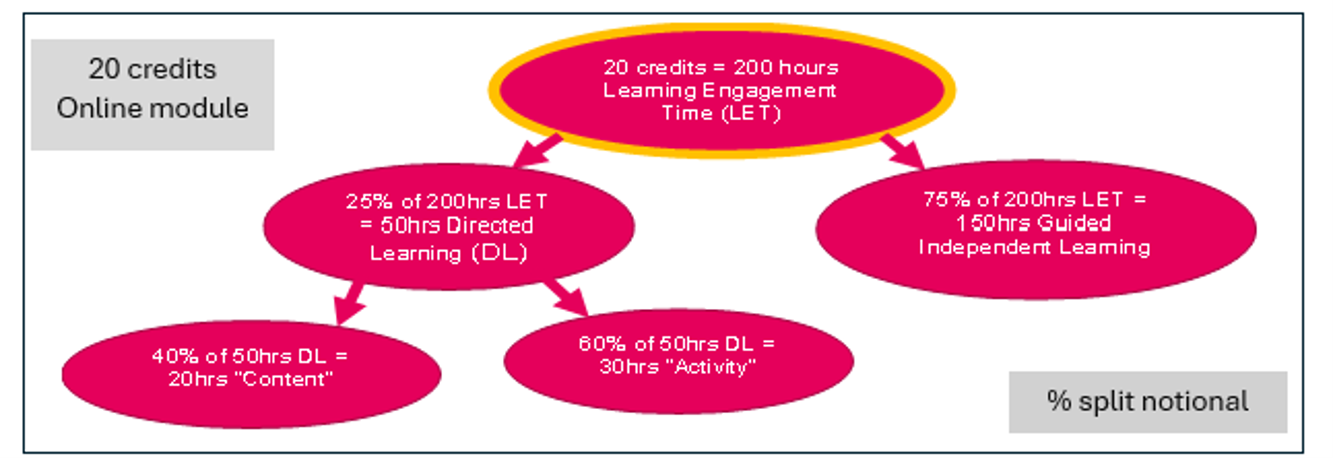
12.9 Examples of ‘Content’ directed learning: Tutor-generated video materials, audio or written content.
12.10 Examples of ‘Activity’ directed learning: automated knowledge checks, discussion forums, enquiry-based activity, peer review, formative assessment.
12.11 Examples of guided independent learning: Wider reading around a topic, externally generated video material, study skills support, revision and summative assessment.
12.12 Digital badges, when used in non-accredited contexts, offer a valuable mechanism for recognising learner progress and engagement in online courses. Rather than acting as formal qualifications, these badges function as markers of achievement, such as successful quiz completion or reaching key milestones within a module.
12.13 They support learner motivation through timely, low-stakes recognition and encourage continued participation by making progress visible. This aligns with principles of formative assessment and self-regulated learning. Digital badges can contribute to a positive learning experience, especially in asynchronous or self-paced environments.
12.14 An article on the D2L blog (makers of NOW) offers some good insight into badges and badging strategy. For support in creating a digital badge, please contact flexiblelearning@ntu.ac.uk
13. Courses at NTU Mansfield
Personalised guided development
13.1 Courses delivered at NTU Mansfield should maximise the benefits of the campus's smaller-scale learning environment, using smaller cohort sizes to enable students to develop strong, supportive relationships with their tutors, and provide personalised, responsive support to meet individual needs. Good practice includes:
- Embedding regular opportunities for one-to-one and small-group academic support throughout the course.
- Encouraging continuous dialogue between students and staff to promote belonging, engagement and academic success.
- Creating structured opportunities for personal and professional development through coaching, mentoring and reflective practice.
13.2 This approach supports guided development, enabling students to receive individualised support and encouragement throughout their learning journey, while fostering a strong sense of community and connection with the course team.
Full-day block timetabling
13.3 Timetabling learning on set structured full days enables students to organise university study and other commitments (e.g. caring responsibilities or work) more successfully owing to the consistent approach of on campus requirements. Where operationally viable and pedagogically appropriate, full day timetabling must be applied to support learners in Mansfield.
Employer involvement
13.4 It is vital that the Mansfield provision remains current with a vocational focus supporting local employers. In order to do so, employer engagement on course development and delivery is essential to the success and future viability of the courses. Employer engagement can be achieved through several existing mechanisms of course design e.g. AWLE.
Change History
Approval Date:
25.09.25
Nature of Revisions:
New policy following redevelopment of QH 12.
Implementation Date:
01.10.25
Approval Date:
10.02.26
Nature of Revisions:
Further clarification provided about options structure, opportunities for formative assessment, and also IFYs. Addition of major project guidance.
Implementation Date:
10.02.26
Approval Date:
01.09.26
Nature of Revisions:
Added the expectations for a course assessment strategy extracted from the existing QH15:Assessment Policy; and guidance for courses delivered at NTU Mansfield.
Implementation Date:
01.09.26